 Back
Back
Restoring loud healthy reefs
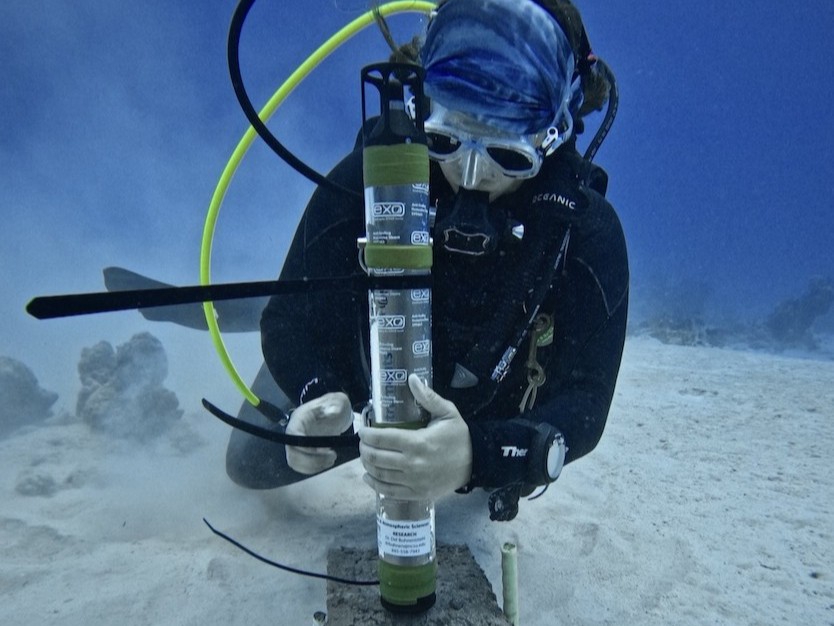
Passive acoustic monitoring efforts included deploying hydrophones at reef sites off the coast of South Caicos, with Mikayla Carrier pictured at coral reef site 'The Arch'. Credit – John DeBuysser.
Restoring coral reef soundscapes to strengthen climate resilience in South Caicos
When coral reefs fall silent
Coral reefs are vital ecosystems that support biodiversity and provide substantial economic value to coastal communities. In South Caicos, they support fisheries, protect shorelines from storm surge, and contribute to tourism. Yet these reefs have faced repeated climate-related challenges in recent years. These include intense storms, coral disease outbreaks, and a major bleaching event, where the relationship between the coral and the algae that lives inside it breaks down due to high temperatures, leaving the coral white. Each event weakens reef structure and biodiversity, reducing the ecosystem’s ability to recover before the next stressor arrives.
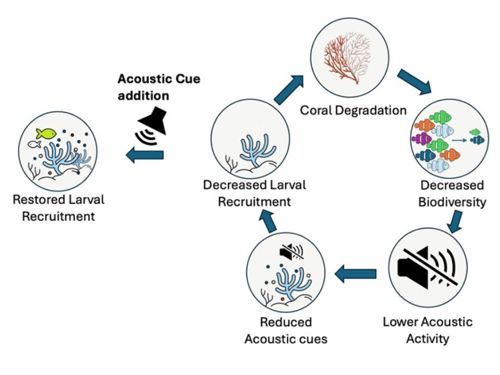
One of the most overlooked consequences of reef degradation is the loss of sound. Healthy reefs are not quiet places; fish, marine mammals, and invertebrates create a dynamic underwater soundscape. Crackling from snapping shrimp dominates the high-frequency range, while fish calls typically occur at lower frequencies. Together, these sounds signal biological activity and habitat usage. When reefs degrade and biodiversity declines, they become quieter. This matters because coral larvae, released during synchronised spawning events, rely on a combination of chemical, physical, and acoustic cues to find a suitable place to settle. Without strong biological sound cues, degraded reefs may attract fewer coral larvae.
Off the coast of South Caicos, restoration and conservation efforts in the Admiral Cockburn Land and Sea National Park are led by the School for Field Studies’ Center for Marine Resource Management (CMRS), who are actively growing and outplanting corals. However, a key question remains; will these sites attract enough new larvae to sustain long-term recovery?
To support natural recruitment processes, we have designed a solar-powered underwater speaker system that replays recordings from healthy reefs. By restoring the acoustic cue to reefs, we aim to enhance larval settlement rates and strengthen the reef’s capacity to recover after bleaching events and storms. If reefs can recruit more larvae, they may rebuild faster following disturbances, increasing their ability to withstand future climate stress.
Our goal is to develop a tool that can complement existing restoration efforts while remaining adaptable under increasing climate uncertainty. We have built these underwater speakers and our team, involving CMRS and North Carolina State University, will assess the effects playing healthy reef noise has on coral larvae settlement this upcoming summer, during peak coral spawning season. At the same time, we will assess whether the same acoustic cues influence the settlement of Caribbean spiny lobster larvae, which are an ecologically important species and vital for the South Caicos economy.
Listening to biodiversity as a measure of resilience
Along with the restoration efforts in South Caicos, it is important to maintain close monitoring of these ecosystems to identify declines in biodiversity and coral coverage. There are a variety of ways to measure the health of coral reefs. Paired with fish surveys and benthic (seafloor) assessments, passive acoustic monitoring adds a continuous, non-invasive element that captures patterns of biological activity over time and reveals changes that may not be immediately visible through traditional survey methods. Many acoustic analyses rely on metrics such as sound pressure levels and acoustic complexity index to estimate overall biological activity on a reef. While these general indices are useful, they do not distinguish which species are contributing to the soundscape. Species-specific assessments remain limited because many reef sounds have not been confidently linked to the species level.
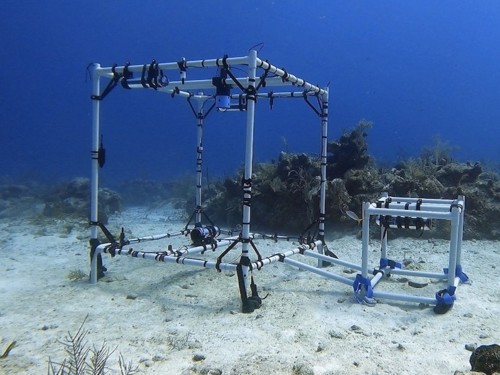
To better understand who is contributing to the reef soundscape, we constructed an Audio-Video Array (AVA), a PVC frame equipped with multiple underwater microphones capable of localising sound sources while simultaneously capturing video. This allows us to directly match sounds to the species producing them. Our preliminary analyses have identified vocalisations from more than 15 species, along with associated behaviours. Developing a species-specific sound catalogue allows us to move beyond general acoustic metrics and track biodiversity patterns more precisely.
We are currently collecting continuous, long-term soundscape data off the coast of South Caicos. Once our catalogue is complete, we will use it to monitor which species are present and active across sites, helping us assess whether reefs are trending toward healthier, more resilient states. In this way, sound becomes both a restoration and a monitoring tool, helping us strengthen recovery while also measuring it.
Written by Mikayla Carrier. For more information on this Darwin Plus Local project DPL00129, led by The School for Field Studies, please click here.